Lineage
Remember tradition does not mean that you never do anything new, but that you will never fall below the standard of courage and conduct handed down to you. Then tradition, far from being handcuffs to cramp your action, will be a handrail to guide and steady you in rough places. – Field Marshal Sir William Slim

The Sri Lanka Army Service Corps traces its lineage to the Royal Army Service Corps (RASC), a British Army corps that was in existence in various forms between 1793 to 1965, and to the RASC’s predecessors. The relationship between the two Corps was very close from inception and continued till the 1950s. During the pre-independence period, the RASC was responsible for providing technical direction to the Ceylon Corps. CS&T and CASC officers regularly attended courses at Aldershot, UK. Similarly, RASC senior NCOs and RASC officers (i.e., the pre-war Adjutants) were seconded to the Ceylon corps. The relationship was formalised with the 1931 Alliance, which put the Ceylon Corps in a special category with four other British Dominions as “Allied Corps” of the RASC. In WW2, the majority of Ceylonese who served outside the country were in the RASC or in the Royal Engineers. After the formation of the Ceylon Army in 1949, the Ceylonese in the RASC transferred to the Ceylon Army.

The Royal Army Service Corps badges included the motto “Honi soit qui mal y pense (variously translated from French to mean “may he be shamed who thinks badly of it” or “shame be to him who thinks evil of it”). The same motto existed in Ceylon Army Service Corps badges till the change to the Republic in 1973. Although the motto no longer exists in SLASC’s post-1973 badges, there are still several common design features shared with the Royal Logistics Corps badge, the present day successor to the RASC. These include the laurel wreath encircling the garter.
Origins of Royal Army Service Corps and its Predecessors and Successors
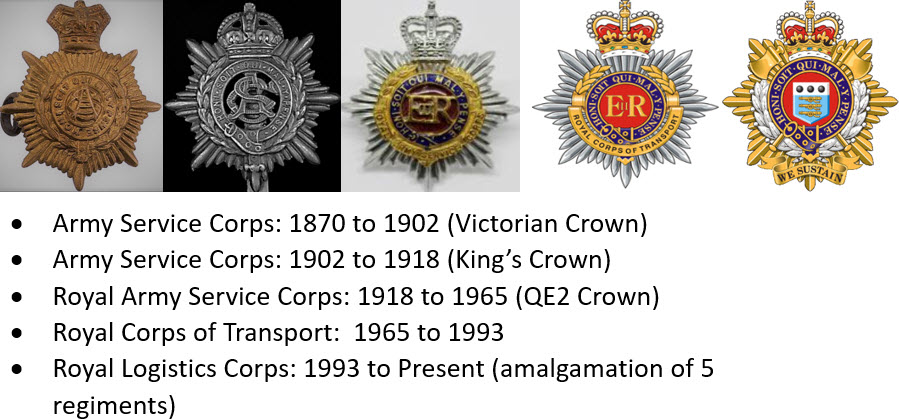
The first uniformed unit to carry out transport duties for the British Army was the Waggoners, which was in existence between 1793-1802. In 1799 it was reborn in the form of the Royal Waggon Corps, later renamed the Royal Waggon Train. This unit was disbanded in 1833. In 1855, during the Crimean war, the British Army set up a new supply unit known as the Land Transport Corps, which subsequently changed its name to the Military Train. In 1870, the Military Train was renamed the Army Service Corps. That unit eventually went on to absorb some of the Royal Engineers’ transport duties. In recognition of its efforts in supplying troops during the First World War (1914-18), it was given the honour of a ‘Royal’ prefix. In 1965 the RASC merged with the Transportation and Movement Control Service of the Royal Engineers to form the Royal Corps of Transport. In 1993, this became part of the Royal Logistic Corps.
The following video clips from 1957 highlight the mission of the RASC in the post-world war II period:
https://www.britishpathe.com/video/the-royal-army-service-corps-reel-1
https://www.britishpathe.com/video/the-royal-army-service-corps-reel-2
 Sri Lanka Army Service Corps - CSC - ශ්රී ලංකා යුධ හමුදා සේවා බලකාය